Rivermark: A Retrofit That Reframed Performance and Place
By Karim Muri, Vice President, Marketing Services and Strategy Development at Kingspan Insulated Panels North America
In cities across the country, many existing structures were designed before today’s expectations for thermal efficiency; occupant comfort and carbon-conscious design became central to the way architects approach the building envelope. At the same time, these buildings often occupy prominent sites where appearance matters just as much as performance.
Located along the banks of the Charles River, Rivermark in Cambridge, Massachusetts, had a highly visible address at 808 Memorial Drive and an aging exterior that no longer reflected the performance or design potential of the site. The mixed-use project called for more than a visual refresh. It required a complete overcladding of the existing building, with a façade solution that could improve thermal performance, reduce air leakage, respect tight site constraints, and bring a new architectural presence to the riverfront.
Jackie Mignone with Bruner/Cott Architects served as one of the project managers on the project and selected insulated metal panels (IMPs) to help meet the project's design goals.
IMPs are exterior panels made with metal skins and an insulating foam core. In a single component, they can provide exterior finish, insulation, and air, water and vapor control layers. For a building like Rivermark, that combination mattered. The project was not a simple reclad of a low-rise structure. It involved a multi-story, mixed-use building with varied existing conditions, tight property-line constraints and a façade that needed to deliver strong performance while elevating its riverfront presence.
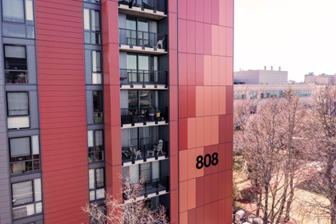 Material detailing in custom clay metallic tones reflects how façade systems can shift a structure from understated to more expressive architectural form.
The building envelope was central to the retrofit strategy. Kingspan BENCHMARK IMPs, including Designwall 2000 panels, were selected in custom clay metallic colors. The color scheme was selected to reflect the brick and terracotta masonry facades of Cambridge's historic buildings nearby. This helped transform the building from an understated concrete structure into a more modern, expressive facade that still fits into the neighborhood contextually. The scheme also helped give the building a warmer, more polished exterior, replacing a dated facade with a more contemporary expression.
Because the project involved overcladding an existing structure, adding too much weight to the façade was not an option. IMPs provided a new building envelope while remaining light enough to align with the team’s retrofit approach.
Bruner/Cott Architects emphasized the value of an integrated envelope approach. “The panels provided a highly efficient, all-in-one solution by integrating finish, insulation, and air and vapor barrier into a single component,” said Mignone.
The prefabricated unitized panel assemblies also helped streamline construction. Because the assemblies could be built off-site in a controlled environment, they arrived ready for faster installation. “This was a major advantage on a project that spanned two winters, as it minimized the time spent assembling the façade in harsh New England conditions,” said Mignone.
In some locations, larger unitized panel assemblies were used, while in others, a stick-built approach allowed the construction team to adapt to existing conditions. The IMPs allowed the team flexibility in the field. Depending on the application, the panels served as the exterior finish or functioned as backup panels, incorporating thermal, air and vapor boundaries.
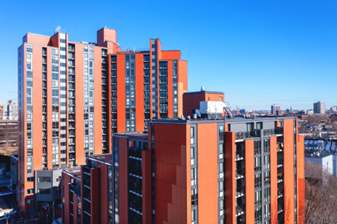 Variation in building heights highlights how façade systems can create cohesion across complex, multi-level structures.
That flexibility was especially valuable on hard-to-access portions of the façade. Some areas rose 15 stories above low roofs, where swing stages were the only practical means of access.
Jack Sherman of Sunrise Erectors, project executive on Rivermark, emphasized the acceleration IMPs provided on the project, stating, “By prefabricating the panels into larger unitized assemblies, the team was able to drastically reduce the amount of work performed from the swings, mitigating that risk and accelerating the pace of façade installation.” The panels also supported the project’s energy performance goals within a very limited façade depth. At the tightest point on the site, the property line sat just 12 inches from the existing face of the building, leaving little room for exterior assembly. Because IMPs combine multiple control layers into one integrated panel, the new envelope could be created within that narrow space without adding unnecessary complexity.
Together, those improvements helped reduce the energy required to heat and cool the building. The result is a retrofit that does more than modernize the exterior.
The target energy use intensity for Rivermark, based on Bruner/Cott Architects’ AIA 2030 pledge, was a 55% energy savings from the code baseline for multifamily housing. The target for the 2030 pledge was 37.8 kBtu/sf/yr. Rivermark came in under – better than – the target at 32.3 kBTu/sf/yr, according to Homeowner’s Rehab Inc.’s tracking of the building's performance.
“Sustainability was a meaningful factor in the decision to use IMPs for this project,” added Mignone. “The panels’ exceptional R-value per inch made it possible to maximize thermal performance within a severely constrained façade depth.”
At Rivermark, IMPs helped extend the life of an existing structure, improve efficiency and create a stronger architectural identity along one of Cambridge’s most visible corridors. By improving the building’s energy performance, the project translates to an estimated $92,500 in annual cost savings for residents, showing how envelope upgrades can support both long-term performance and day-to-day savings.
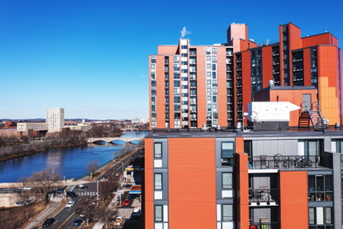 The building’s presence along the riverfront demonstrates how envelope systems can strengthen visual identity within urban settings.
Bio: Karim Muri is Vice President of Marketing Services and Strategy Development for Kingspan Insulated Panels North America. Muri has led strategic marketing in the construction products market for nearly 20 years. His global experience includes leadership roles in Australia and the United States, working in both the residential and commercial building sectors.