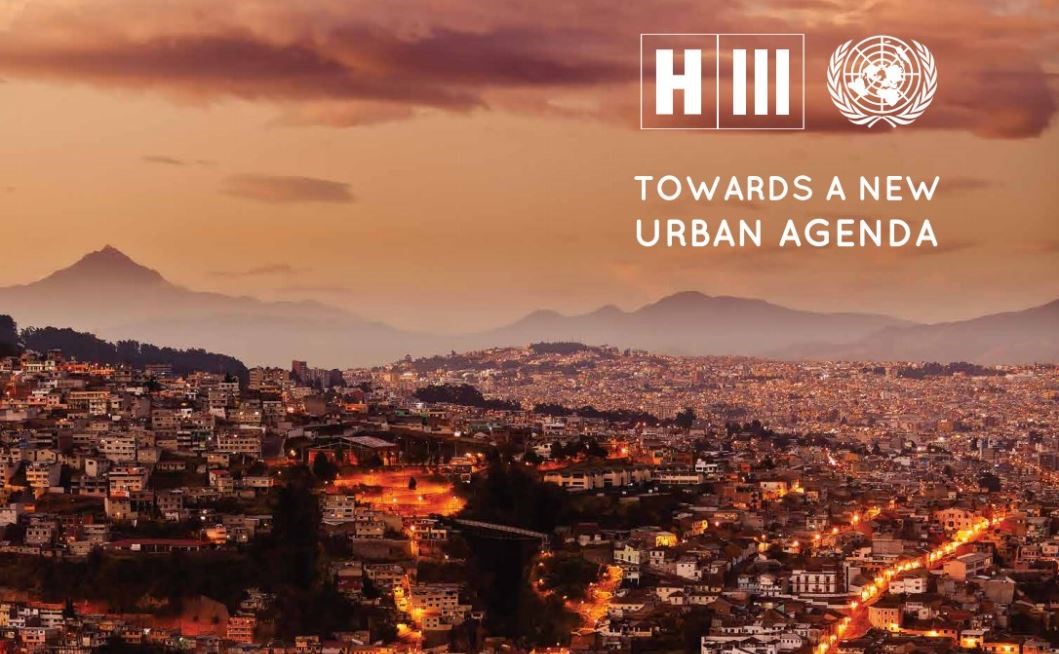
Image: Quito, Ecuador - United Nations Habitat III Conference on the New Urban Agenda
By Phil Bona, AIA
In a time of rapid change, generational transitions, and significant global population growth, attainable housing remains a fundamental need and expectation of the human experience. As such, the world’s housing crisis and its impacts on social equity one of the most difficult challenges facing leaders and policymakers.
Habitat III was the third convening of the United Nations Conference on Housing and Sustainable Urban Development. It took place in Quito, Ecuador in October 2016 and was attended by all member states of the United Nations and, national leaders from the American Institute of Architects. Together their aim was to reinvigorate, the global commitment, to sustainable urbanization, and focus on the implementation of a new more sustainable urban agenda. It was determined that this strategic set of common smart/resilient growth guidelines is accurate and urgently needed.
The New Urban Agenda (NUA) is an agreement between nations that the practice of making cities must strategically evolve in the same way that the city of the future will evolve. If we go forward asking better questions we will get answers suitable for the urban Eco-District of the future. We speak today of a new social and cultural framework based on equity and diversity, so where is that written in your local Land Use & Development Code? NUA defines tactical issue areas like providing “Housing First” for very-low-income people; policy elements like mandated subsidies for affordable housing, tiny homes, modular buildings, and Accessory Dwelling Units (Granny Flats) that need to be allowed and incentivized on every single-family zoned property over 5,000 sq. ft. in America. It proposes new policies in support of everyone’s “Right to the City”, including social responsibility, equitable resources, land for walkable housing and jobs, multimodal mobility, wireless infrastructure for civic participation and interaction, and reliance on living, working, playing, learning and farming in a sustaining carbon neutral and resilient environment. It recommends diverse and equitable communities that focus on healthy urban living, mobility, job retraining, agriculture, and integration with nature.
In this spirit, aligned with the 2020/2030 Challenge and the Living Community Challenge frameworks, we, as architects and citizens can, for the benefit of future generations, create and recreate sustainable and resilient communities and buildings that are:
- healthy for all elements of life
- nurturing and generous places that promote healthy lifestyles for everyone
- net positive with respect to water and energy as baseline thinking
- vibrant interactive mobile communities that generate their own energy and capture and treat all the water they need locally
- designed using multi-purpose spaces where nothing has only a single purpose and everything has multiple benefits to the community and the environment
- regenerative places and spaces that are universally designed for multi-generational peoples in concert with local natural ecosystems
With a common professional vision, Architects can become trusted spokespersons for positive change in the built environment (or at least of your own greater neighborhood). You can prepare your community for the smart growth strategies needed for its healthy resilient future. Architects can come together as a unified voice now to deliberately change the conversations of our country to focus on the cannons of the New Urban Agenda and align with smart regional resiliency policies. As Boyer and Mitang wrote in “Building Community,” “The nobility of architecture has always rested on the idea that it is a social art.”
In our role as citizen architects, we can bring about a coalition of national leaders, local mayors, and neighborhood advocacy groups in towns and regions across the United States, to demonstrate how to effectively maintain a diverse, equitable, built environment while managing increasing population growth by the hundreds and thousands of people who will relocate and be born into increasingly urban and suburban neighborhoods.
In 2018, the AIA theme has been “Blueprint for Better” with the hope of exposing architects, who are willing to rise above the historic norm, to think, design and advocate as community facilitators and leaders. AIA is developing community toolkits out of the work of Habitat III as a result of the successful Blueprint for Better A’18 Resolution. These toolkits and new public relations programs will be used by Local Design Assistance Teams L/DATS as an aide for downtown urban, urban infill, suburban, rural, and agricultural communities in the United States that will be impacted by another 100 million people over the next 30+ years. It is your call whether architects are the ones to make a significant difference in regenerating local communities to grow sustainably and resiliently. Specifically, the AIA Committee on the Environment and its committed members, whether emeritus or new, leaders or followers, are the most qualified and connected body of individuals to ideate, reshape, and implement new policies and Climate Action that will protect the future of local Built Environments across the country. Are you hungry yet? Join or rejoin AIA COTE®, get involved, and make the difference in your neighborhood; do it for your grandchildren.
Philip J. Bona, AIA, is a member of the AIA Strategic Council; was the 2017 President of the AIA San Diego Chapter; is a practicing architect & planner with AVRP Skyport; is a former adjunct professor at the NewSchool of Architecture + Design; and he previously served as Assistant Vice President of Architecture and Planning for San Diego’s Redevelopment Agency (CCDC).