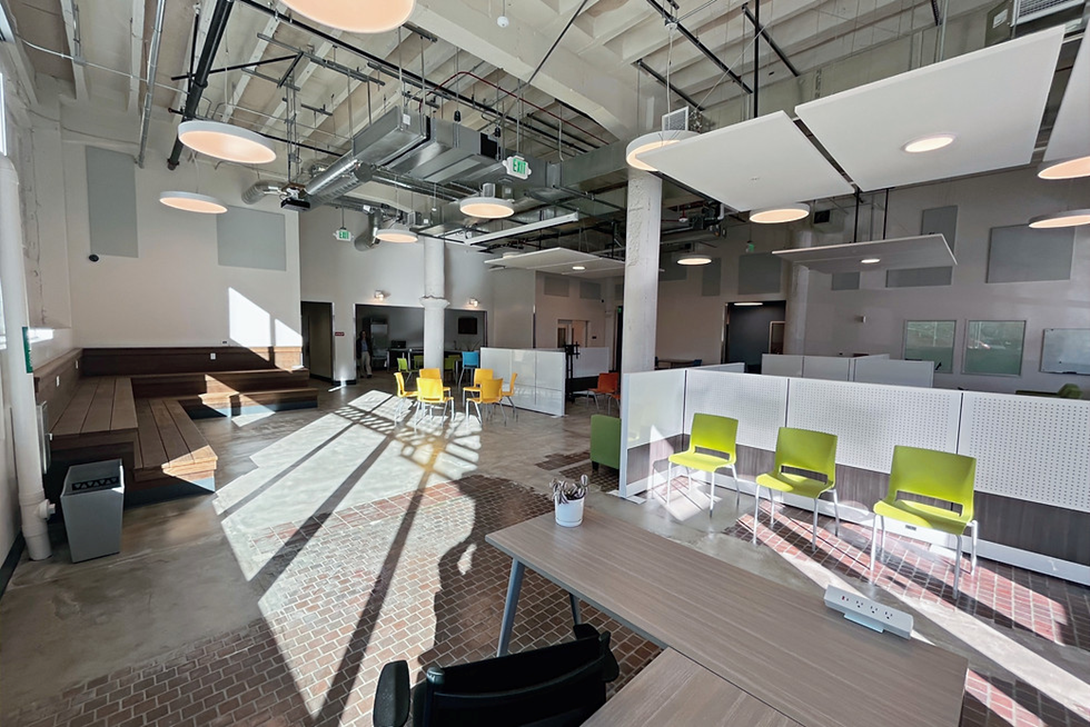
The new health and wellness center for unhoused, young adults features a large communal space
City Opens New Health and Wellness Center for
Young Adults Experiencing Homelessness
As part of San Francisco’s push to serve and support young adults experiencing homelessness, a newly opened center in the Lower Nob Hill neighborhood, on the edge of the Tenderloin, aims to provide critical health and wellness services, from showers to laundry facilities and even a hair salon.
Designed and managed by the Public Works Bureau of Architecture, which also provided construction administration services, the new Transitional Age Youth Health & Wellness Center at 888 Post St. will be open 24/7, ensuring that unhoused adults – between 18 and 27 years old – will have access to personal hygiene opportunities and essential services.
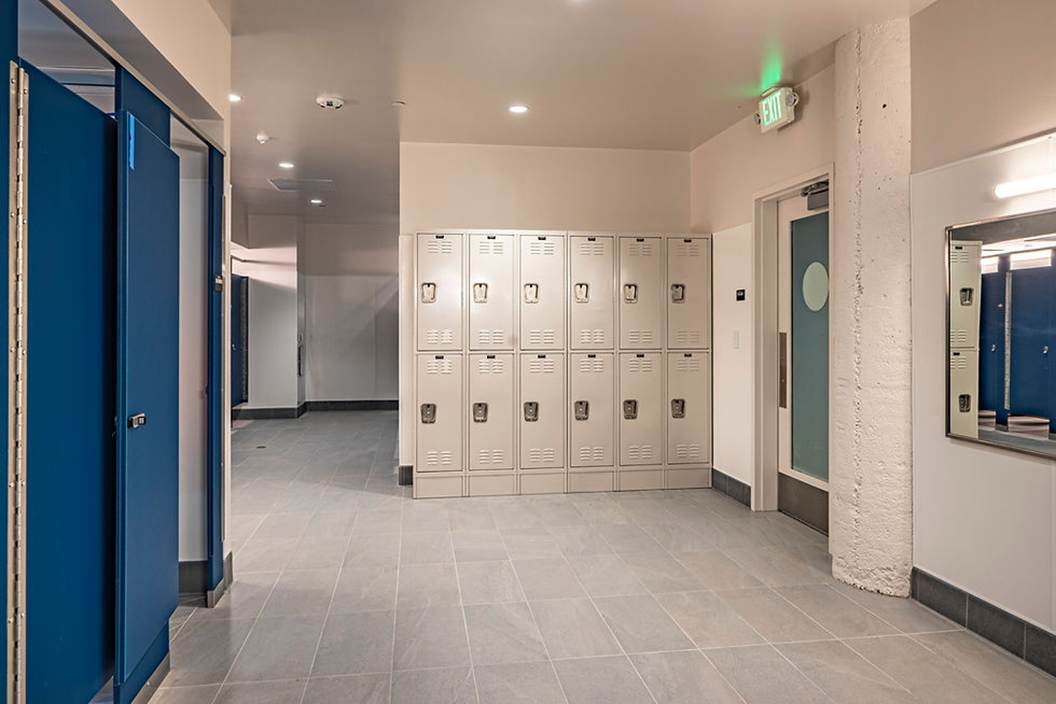
The center includes lockers, showers, restrooms and changing rooms.
The need is real. The City’s Point-in-Time count in 2024, the most recent available dataset, showed there were more than 1,100 unhoused young adults, ages 18 through 24, in San Francisco.
“The opening of the TAY Health and Wellness Center is a significant step forward in our commitment to addressing the special needs of young adults struggling with homelessness,” said Shireen McSpadden, executive director of the City’s Department of Homelessness and Supportive Housing.
The health and wellness center project, a partnership between the Department of Homelessness and Supportive Housing and San Francisco-based nonprofit GLIDE, looks to empower young adults by maximizing their ability to live and work in the community, offering them the support they need to pursue their goals. The floor above the new center houses an existing congregate homeless shelter for young adults.

Officials cut the ribbon for the new center in the Lower Nob Hill neighborhood.
To mark the ribbon-cutting of the new health and wellness hub on Jan. 29, scores of City officials, community members and GLIDE workers – surrounded by refreshments and colorful balloons – joined together in song, prayer and celebration inside the brand-new center.
“This really was a group effort, working alongside everybody's vision, to create this incredible space,” Public Works Director Carla Short told the crowd. “We are super excited to be part of it. We are honored to have contributed to it and we look forward to seeing what the future holds.”
Public Works architect Peter Engel, who helped design the new center, shared the sentiment.
“This is a very important project, in my opinion,” he said. “Because it’s trying to provide a safe place and more for youth of this age group who are basically on the streets. And part of the purpose of this place is to meet basic functional needs.”
The roughly 10,000-square-foot space on the ground floor of a three-story, City-owned building at the corner of Post and Hyde streets features a range of amenities. They include secure storage for personal belongings, a kitchenette, a pantry, a community space to watch movies and play video games, a quiet room, a small clinic, computer workstations and even an outdoor area for pets.
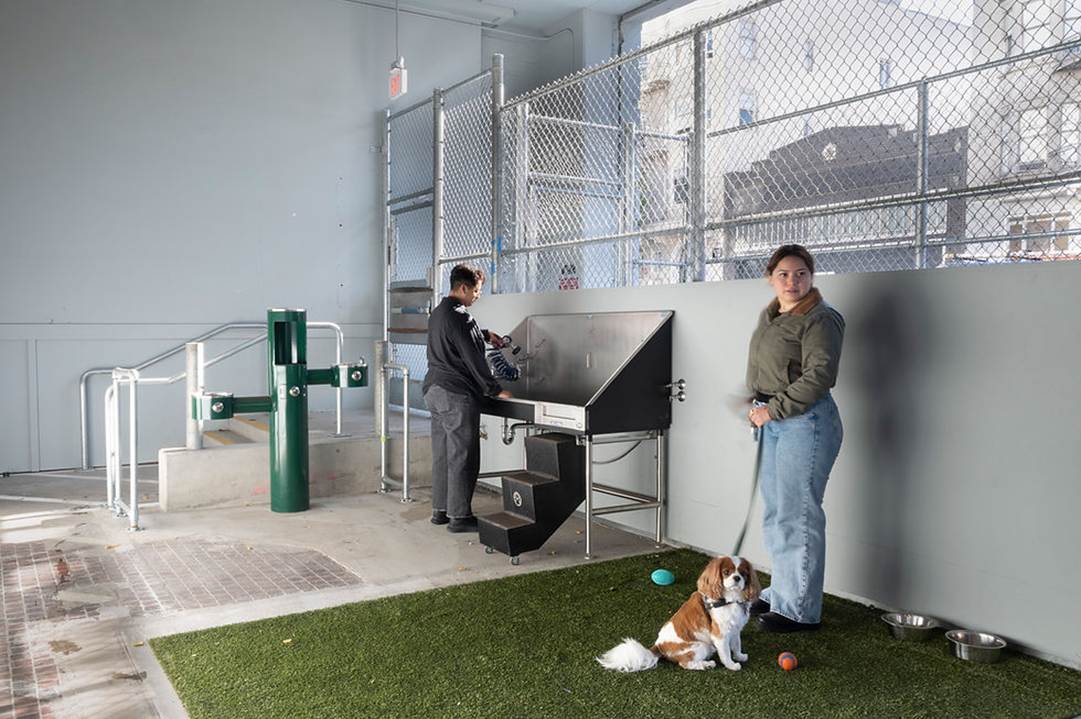
An outdoor space for pets includes a washing station for them.
The fenced-in patio space – with a patch of artificial grass for pets and plenty of seating opportunities for visitors – also includes a pet washing station. “And if you think about it, that’s really important,” Engel said. “It’s not like an extra thing. People who live on the street or spend a lot of time on the street, for whom a pet is really an important part of their life, they need to wash and their pet needs to get washed.”
Without those types of amenities and a low-barrier-to-entry setup, people may not want to come and take advantage of the center, making it harder for them to get connected to services, he added.
Turning the space – which once housed a car showroom – into a welcoming, functional sanctuary for unhoused, young adults was not without its challenges. For one, designers had to make sure they afforded patrons a certain level of privacy while at the same time providing an inviting environment.
“There’s a push and pull between making it open for natural light and making it pleasant and having it protect the people inside” from being viewed by people from the outside, Engel explained.
The solution: giant shades that can be pulled down to adjust the visibility to everyone’s liking.
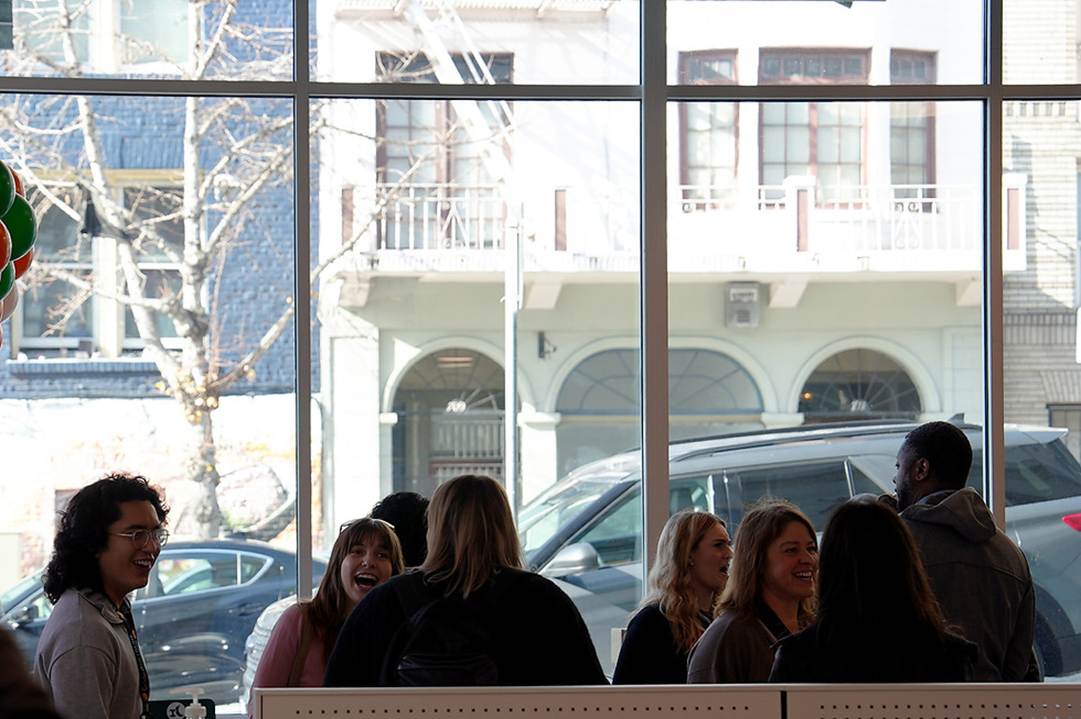
Attendees of the Jan. 29 ribbon-cutting event share a laugh.
Additionally, designers and crews had to contend with an uneven, worn concrete floor that needed to be leveled out to meet accessibility requirements. “It had been hacked up and patched and there were previous trenches in the floor,” Engel said. “And that proved to be very challenging. You know, if something is 1% too steep, that’s not good enough.”
Designers also had to make sure that staff and case managers are able to monitor the communal space in the center of the floor from their offices along the perimeter. That’s why generous windows open a sightline from the offices to the large, multipurpose room.
“So people actually at their desks can look out and see what’s going on,” Engel said.
Even within the communal space in the middle of the center, designers wanted to give staff and patrons the flexibility to adjust the environment to their needs.
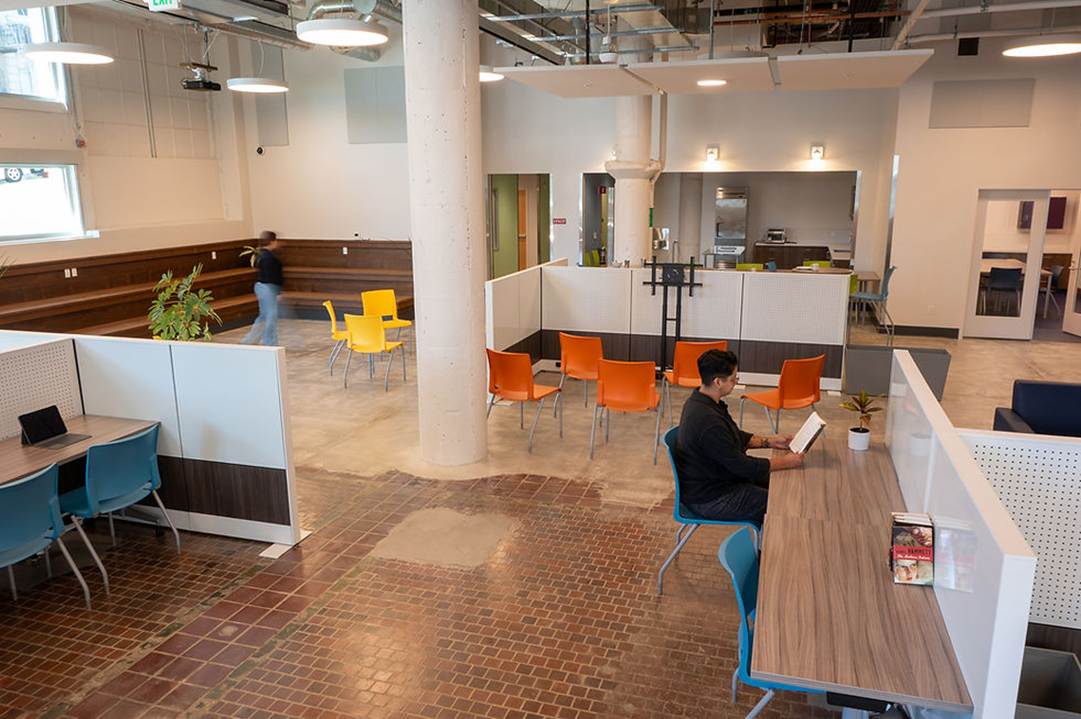
T-shaped partitions allow staff and patrons to create different zones within the large communal space.
“The idea was to make the big multipurpose space have flow,” said Patty Solis, senior architect and section manager with Public Works' Bureau of Architecture. “And that was accomplished by having it organized with these T-shaped partitions, which are very low in height.”
That allows people to create zones for different activities, from reading to working on a laptop to playing video games, Solis said.
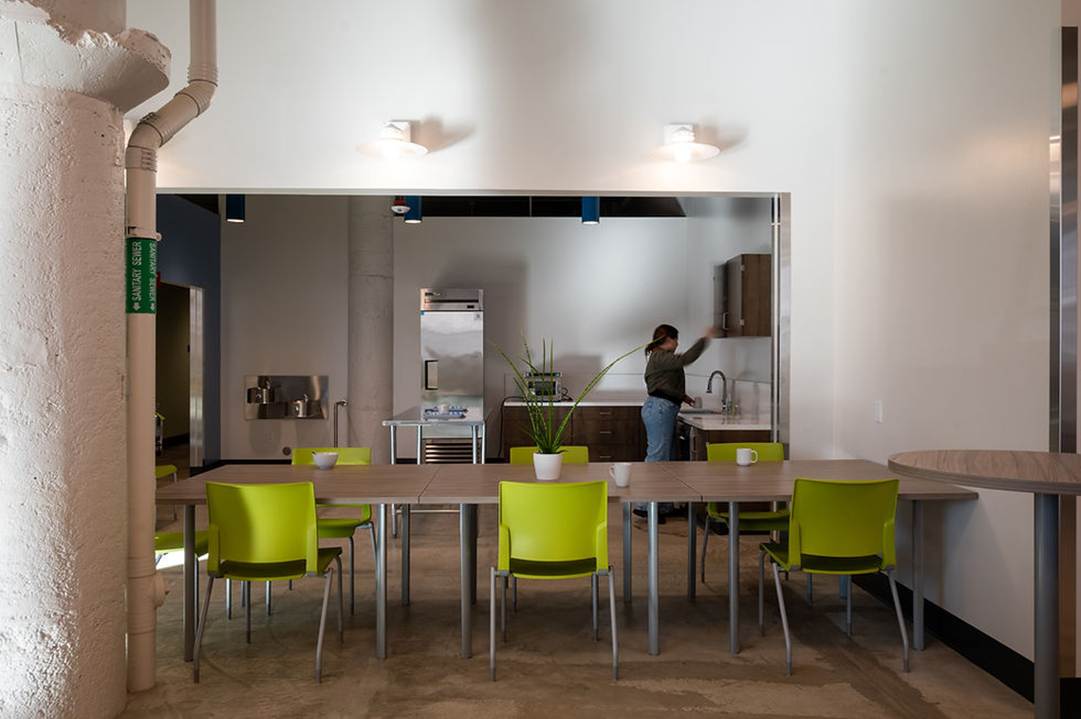
The center includes a breakroom area for patrons to share a meal.
Tiered seating in a corner of the space is intended for watching movies on a dropdown screen. A small lunch area allows patrons to heat up their food. Acoustic panels floating overhead and on the walls are designed to prevent noise from bouncing off the concrete walls and high ceilings.
“I think this will provide a huge service to the neighborhood,” Solis said of the new center. “Help alleviate some of the stress from being out on the street for a lot of these youth and be a nice, quiet respite for people to catch up, take a breather, get some help.”
This article was written by the Public Works Communications Team. Photographs were provided by Public Works.