By Steven E Loomis, FAIA, LEED AP
Police have received much negative press in recent times regarding the use of excessive and even deadly force. These seemingly uncommon yet alarming incidents have sparked national debate and even riots over how police are trained, police racial profiling and when use of force is appropriate and necessary.
While these issues cannot be solved directly through new facilities, they can be addressed in a revamped training regimen that is then translated into an architectural program and response. As a follow up to the presentation developed last fall at the AAJ Conference and presented by AAJ Members, Brian Super, AIA and Rick Macia, AIA, this article seeks to capture some key concepts as illustrated through two recent projects; One in Miami and another in the York Region of Ontario.
 Rendering of the York Regional Police Training and Recreational Facility, provided by AECOM
The evolution of police training facility design
Police officer training is constantly evolving and it is indeed much more dynamic and intensive compared to regimens even as little as ten years ago. Likewise, police training facilities have been reflecting this new environment. Recent trends include:
- multifunction training rooms / shared community use
- simulation / mock up rooms
- dynamic training environments (situation response)
- instructor/trainee interaction opportunities
- computer and video simulation
- focus on safety and security
These training modalities have necessitated facilities that promote all the above, so many new buildings have the following program components:
- computer classrooms
- auditoriums or community rooms (community access)
- defensive tactics
- virtual firearms trainers (shoot – don’t shoot)
- live fire dynamic firearms range
- virtual driving simulator
- live emergency vehicle operation course (EVOC)
- scenario simulation room
- mock courts
- training lab for forensics (increasingly more specialized)
- simulation cityscape or village
 Rendering of the York Regional Police Training and Recreational Facility, provided by AECOM
Sharing facilities and cost
Many departments are combining training centers in a regional facility that is shared among the jurisdictions due to the higher costs of developing these complexes. Larger facilities can be constructed with a variety of training functions in this shared cost operation. While the costs can be shared, departments need to look at the costs for including officers travel time to remote locations. In addition, the participating departments need to agree on the sharing and schedule priorities for the facilities.
Many community colleges and technical schools are joining in this push for regional and complex training facilities with their own increased interest from their students in criminal justice facilities. This can also be a source of income from the college in charging rental fees for the facilities. However, the overall fact that this is an outreach activity with the community and the law enforcement agencies is of great benefit to building relationships.
Law enforcement training centers can serve as a vital community function if they are located within the community for ease of access. Many departments hold citizen academies to foster community support and vigilance in protecting their own neighborhoods. One example of an outreach program is a self-defense training course for women taught at the Fairfax County Police Headquarters in Fairfax, VA. The program not only empowers women, it also breaks down barriers between the community and the police. Participants have expressed walking away feeling much more connected to the local police service and more likely to work with police rather than fear them after completing the class.
Starting the training in high school
Another type of outreach is at The School for Law Studies, Law Enforcement, Homeland Security and Forensic Sciences in Miami, Florida, the first school of its kind in the world. Miami-Dade County Public Schools and The City of Miami/Miami Police Department have joined forces to provide high school students with a one of a kind opportunity in the areas of law and law enforcement. The focus is to provide a rigorous education across all the content areas while tying in the programs career objectives. Students that are accepted into the program have access to forensic science labs, courtroom labs, and computer simulation centers.
Students also have certification possibilities in a variety of areas before graduation, with the opportunity to attend dual enrollment programs with Florida International University, University of Miami and Miami-Dade Community College, and complete internships in their respective area of study. The curriculum includes three different academies; Homeland Security, Law, and Forensic Science. The program currently has an enrollment of nearly 380 and offers career alignment for Police Officer, FBI/DEA/Military Police/ Marine Patrol and Coast Guard.
This project was constructed by the City of Miami in the downtown area next to the existing Police Headquarters with ease of access to mass transit the commercial core. For the high school the project includes 17 classrooms, chemistry/forensic lab, biology lab, moot courtroom, media center, dining and administration.
The Miami Police Academy which shares the facility includes recruit classrooms, in-service classrooms, live firing range, defensive tactics, simulator room, SWAT area and emergency operations center for the police (DOC) along with DOC dorms. The two programs share the main auditorium, gymnasium, and the secure dining courtyard.
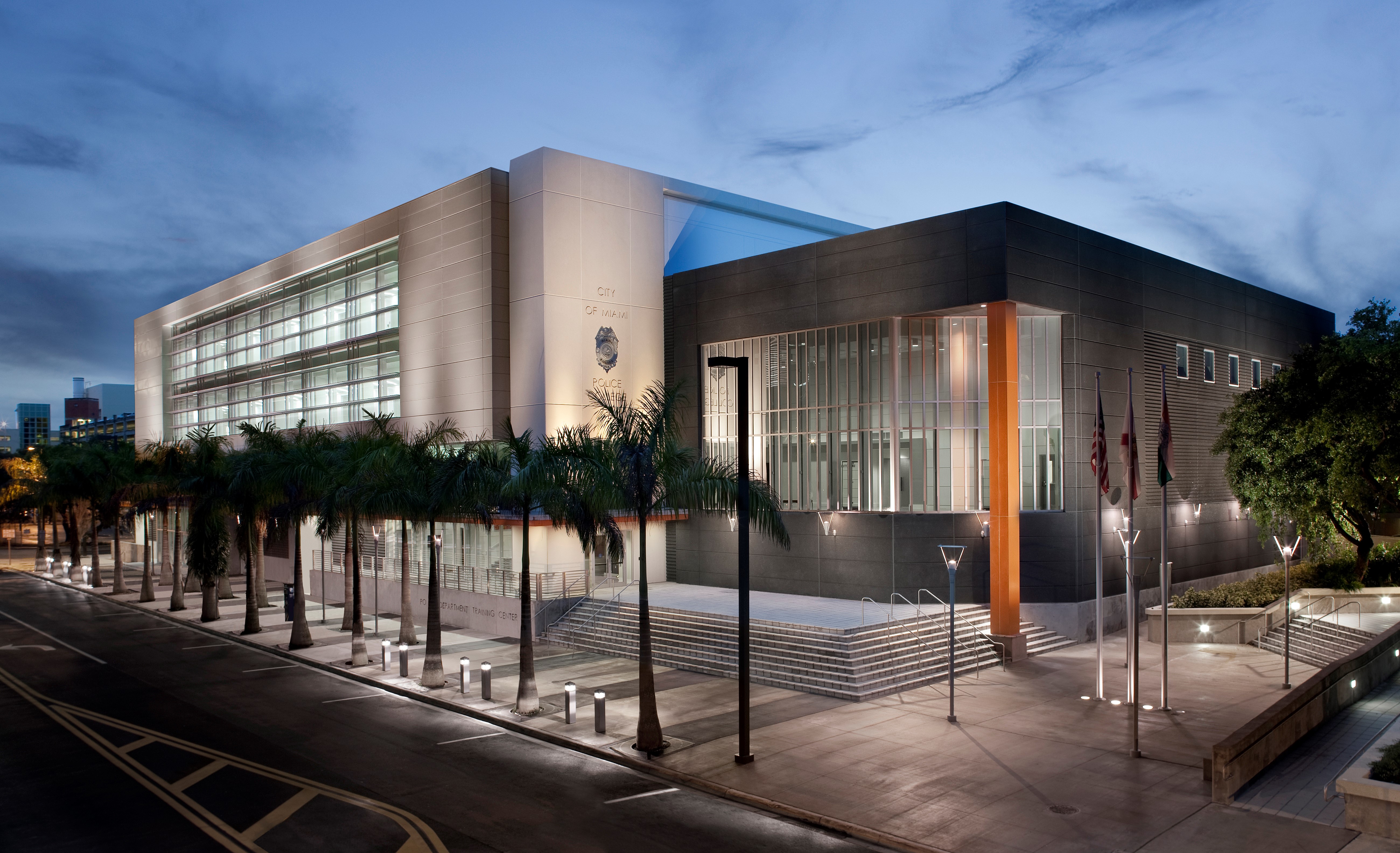 Photograph of The School for Law Studies, Law Enforcement, Homeland Security and Forensic Sciences in Miami, Florida. Photo provided by AECOM
This program is unique for this level of community engagement but has had great success with its students, many who have passed the State of Florida 9-1-1 Certification, dual enrolled in Miami–Dade College and finally graduated to further criminal justice studies or positions in the industry.
Bridging the gap
It is clear that this police training is changing and engagement opportunities can help to bridge the gap not only through proper training but indeed through strong community partnerships.
_______________________________________
Steven E Loomis, FAIA, LEED AP is the Principal for Public Safety Design at AECOM. In his current position he is responsible for the firm’s public safety projects including space and master planning studies, renovations, additions and new Police, ECC/EOC designs. He has more than 30 years of professional architectural practice, and has promoted programming, planning and design focused on public safety issues. In the past 20 years he has completed a number of new police service facilities, and public safety operations centers. He can be reached via email at steve.loomis@aecom.com.
(Return to the cover of the 2016 AAJ Journal Q3 issue)