By Steve Leone, AIA / Blueprints for Senior Living newsletter, December 2016
It’s difficult to know what it’s like to be a resident in a long-term care community unless you are one, so I decided to be one for 24 hours. What I learned gave me insight into how people experience spaces from a physical and emotional point of view.
I became a new resident of Parker at Monroe (PAM) in Monroe Township, New Jersey for a day. As an architect with more than two decades of experience designing senior living environments and for the Staff at PAM with whom I have worked with many of those years, this exercise was a new experience, and one that everyone working in designing or operating long-term care environments should experience first-hand. I expected to discover new insights about the physical environment; I was not prepared for my emotional responses.
Parker at Monroe, A Francis E. Parker community, is designed on a small home model; 8 homes, each accommodating sixteen residents, each with multiple living rooms, kitchen, and access to the outdoors. Homes are designed as an open “L” or boomerang shape to maximize resident legibility, staff visibility and passive supervision. The scale and feel is residential, familiar and traditional. The entire campus is conceptually modeled on a village community.
As a new resident, this would be my first 24 hours in a new environment that was going to be my new and permanent home. I did a pre-admission interview with a social worker and a nurse. Here is what they found out about the future me: I am an 84-year old man who has been married for 53 years, who is now dependent on my wife for transportation and for many small aspects of daily life. I raised a son and daughter who are now grown with families of their own. I have diabetes, peripheral neuropathy, macular degeneration, hearing loss, and arthritis in my knees and shoulders. I arrived with my requisite forms, list of medications, the clothing I prefer to wear, and a few pieces of furniture and personal memorabilia.
Like many people my age, I am anxious about change, restless, am motivated, but fairly quiet and keep to myself. I tire easily and have trouble focusing. I am not fearful of the move, but have anxiety about what this major change will entail. It made me anxious to think there would be an entirely new set of rules and systems for me to understand all at once.
What I realized during the interview was I was feeling sad for future me because nearly all my life was behind me. I had become dependent on my spouse and no longer able to live at home. I was once independent and now I need people to do things for me. The real me was already feeling defeated. The real me also realized I need to focus on living a full life while I still can.
Image credits: Spiezle Architectural Group
I was given some tools to help simulate the physical disabilities of my profile. These include goggles that where obscured (scratched) except for a 1/8 inch diameter circle in the center. I had to wear thick construction gloves that made hand coordination more difficult, ear plugs to simulate hearing loss, and really uncomfortable plastic inserts in my shoes to simulate neuropathy. I also chose to confine myself to a wheelchair because the knees just aren’t what they used to be.
The get-up was a little goofy but all the staff played along, so after I was processed and shown to my room, I decided to head out and meet people. I was met with curiosity and suspicion at first, but that gave way to smiles and “Are you trying to be a robot or something?” type questions. It was clear I was not a real resident, but it didn’tt take long for residents to accept me into their community. It made us realize there is a need for better, more discreet tools to conduct such research, and that a little make up to make me look older might make the experiment more authentic.
Staff took me on a tour of the entire facility and escorted me in my wheelchair. We even ran into the Executive Director who by standard practice, knelt, introduced himself, shook my hand and wished me well. This is a man that I’ve known as a client and friend for many years who normally greets me eye to eye and with a firm hand shake. Everything I’d heard and read about how compromised you feel when you can’t stand and look someone in the eye came back to me that instant. This encounter was as awkward as it was friendly.
By that time it was approaching 5 pm. and staff informed me I was free to come to dinner at my leisure. They would escort me to my table if I liked, which I took them up on, feeling a little tired from the tour. I was ready for dinner and the food was plentiful and tasty. I was offered seconds, dessert, coffee, anything I wanted, just ask. The staff did everything to cater to me except let me be my independent self. This raises a quality of care issue: how can staff balance helpfulness with a resident’s desire and ability to be independent, even if they are wheelchair bound? I decided to wheel myself back to my room. It took a while to get there. It felt much farther in a wheelchair than I thought. It was 6:30 by the time I got back to my room and I was tired.
Later that evening I left my room to see who was out and about. Six residents were clustered around the TV watching Jeopardy, sound up loud. Some were paying attention to the game, some were asleep, a few staff members were there watching with them. It felt like family gathered around the TV, which was comforting. The living room felt comfortable and was the right size for the group. It reminded me that residents feel comfortable in small groups, and that the scale of surroundings contributes to their sense of security. By 11 pm activity in the common areas had quieted down so I decided to call it a day. It would have been nice to have a family member with me today I thought, but I got through it. A staffer on night rounds came to check on me, it was comforting. A different staff person showed up 15 minutes later to do the same thing. This felt odd and unnecessary; almost disruptive. [I was later told that staff stops in frequently to check on newly admitted residents, and after a couple of weeks staff meets with the resident to see what is working and what is not.]
The next day I woke at 5:30 am, my usual time. I had slept well. I dressed and headed out across the living areas only to find the lights still dimmed, the TV on, and the house exit doors still closed. I came across a nurse and one aid. The common rooms were noticeably cooler than my room. This made me feel a little uncomfortable. In later conversation, aides complained about it being cool and that they had to resort to wearing sweaters and shawls. As I tooled around in my wheelchair I was greeted by a staffer eager to escort me. I said I would rather go it alone, and he reluctantly gave in to my request. It takes some convincing to be independent.
I was ready for breakfast at 6:45 am, so I headed off to the kitchen to find myself some juice, coffee and something to eat. It felt like I was on a normal schedule. But in the kitchen, nothing was available to me within reach so I couldn’t help myself. Soon the morning staff appeared and made it clear that they would help me with anything I wanted. What I wanted was to do it myself!
As friendly and accommodating as they were, the staff would not let me get my own breakfast, so I headed for a table and waited to be served. Quickly they brought everything I asked for and I was joined by a staffer and another resident. We had a pleasant conversation over coffee for the next twenty minutes. All of this I thought, I could have managed on my own.
The rest of the day was a pleasant mix of activities and interactions with residents, and before I knew it my 24 hours as a resident was coming to a close. How did I feel? I tired more quickly than I thought, I was continually frustrated by my own physical impediments, and that there were many adjustments and some compromises I still needed to make. I realized this was going to take time.
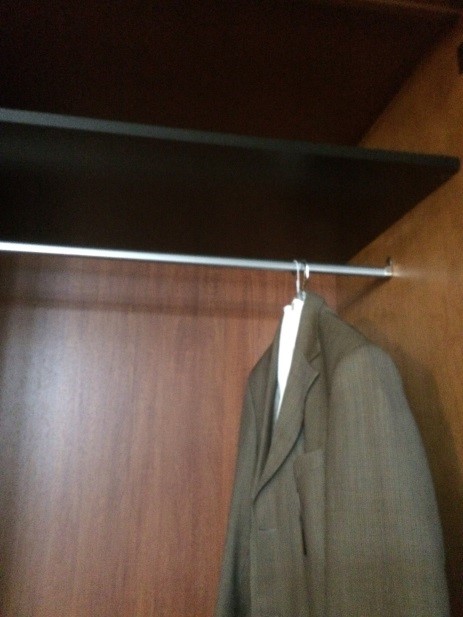
There were many little things about the facility I took note of. The floor transition strip between bedroom and bathroom was frustratingly difficult to navigate in a wheelchair though fully ADA compliant. Overhead lights felt harsh. The night light seemed too bright and I wanted to turn down its intensity. We have since found better lighting options. We had furnished the room nicely with comfortable furniture, but I thought that the side chair was too close to the TV and too heavy to move. The size and proportions of rooms felt right, although the overall size of the 16-resident small house was, well, not so small. Traveling the length of the house in a wheelchair was tiring. The hanger rod in the wardrobe was too high even with my long arms. The position of the light nearest to the wardrobe made it difficult to see into it; too many shadows. Moving forward, we are looking for wardrobes with built-in lighting and no toe kick. So there it is, I found a handful of things to improve upon. Mission accomplished.
 |
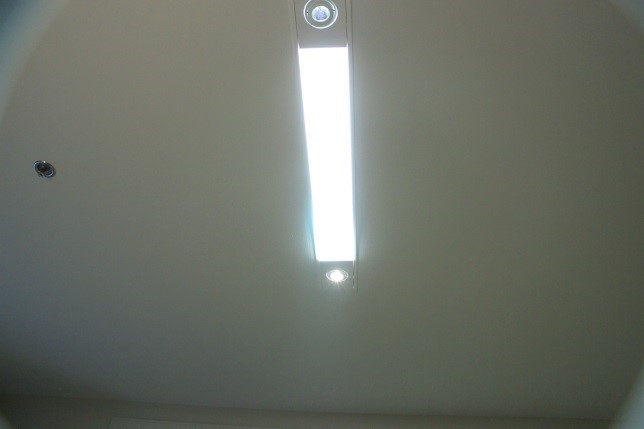 |
Image credits: Spiezle Architectural Group
Parker at Monroe is a client who is actively involved with design of its facilities and we are continually studying and improving them. All spaces meet ADA accessibility standards, but this is not always sufficient. Sometimes you have to buck the system and be non-compliant for a reason! What we continue to explore with Parker is how assistive design can accommodate the range of needs of specific residents to the greatest extent possible; from people who need assistance with toileting, or residents who because of age and frailty cannot reach the faucets at the sink, to understanding independence through the lens of compromised accessibility.
Becoming a resident for 24 hours was a valuable experience. At times a little goofy and not always authentic, but enlightening none the less. It reinforced that we need to continually improve upon the process of understanding what residents experience in long-term care environments. We need better tools to do that. We need to understand these environments experimentally from many points of view.
Fixing floor transitions, choosing better lighting and adjusting temperature settings are easy. Paying attention to the emotional experience is a subtler exercise. Residents aren’t prepared for this life transition. Change can cause anxiety and fuel feelings of compromise and loss of dignity. My role, among many, is to create places that allow people to retain dignity and independence in settings that provide the care and assistance they need, to the degree it is needed. One day I may truly know what it is like to experience long-term care. Until then I want to make sure it is as good as it can be.
_____________________________
About the author

Steve Leone, AIA, LEED™ap, is the founding member and Director of LEAPp, Life Enrichment Aging-in-Place professionals, a think tank of high level industry experts focused on the development of centers for social enrichment for seniors. He is a senior level, award-winning design professional with over thirty years of experience in the field of architecture. He has extensive background in senior living/healthcare environments and sustainable design. His passion and depth of experience has brought steady repertoire of special projects and speaking engagements.