San Diego California, known as America’s Finest City, is the 8th largest city in the United States by population. In 2015, its Association of Governments (SANDAG) completed the “San Diego Forward: Regional Plan” that forecast 1 million additional citizens to inhabit the Region by 2050. It is anticipated that over 50 percent of this growth will be a result of natural local births, and the rest from immigration into the County from inside and outside of California as well as Mexico. This demand translates to over 400,000 additional housing units that will require new construction of at least 12,000 units per year. Less than half that was built in 2016 and trended similarly in the past decade.
As rent and sale prices continue to escalate to beyond what the market will bear in San Diego, the projected median price of a home, currently at $550,000, in 2050 is expected to be $1.6 million. This pervasive rising cost of housing is not sustainable. Left to the marketplace for the next 33 years, and expecting acceleration of personal income and workforce reductions, our grand-children and great-grandchildren face certain hardship and potential chronic homelessness as a generation.
In 2017, the AIA San Diego (AIASD) has rallied a broad coalition of allied groups, under the mantel of Housing YOU Matters, including the Building Industry Association, Habitat for Humanity, the Urban Land Institute, the San Diego Association of Realtors, and the San Diego Architectural Foundation, among others to take on the task of finding more solutions that would result in greater housing affordability over the next 33 years.
Born out of the successful Regional Urban Design Charrette model from the year 2000, “Housing the Next Million in the Silicon Valley” (that I led as President of AIA San Mateo County), the November 4-5, 2017 Regional Urban Design Charrette for Housing the Next 1 Million (HN1M) in San Diego County will produce analysis and new visions for solutions to the housing affordability crisis. Interdisciplinary teams, made up of volunteer architects, planners, landscape architects, engineers, builders, universities, community representatives, developers, city agencies, community banks, realtors, and others are coming together monthly to study regional and local solutions for a leaner housing industry and more sustainable and resilient land use following the criteria set out in the recently approved San Diego Climate Action Plan.
AIA-led Planning and Design teams will meet in November for a 2-day Charrette to target 12 designated transit growth areas around the county. The goal is to employ best practices in environmental planning and transit centered growth design, to create visualizations that demonstrate where and how the County could physically absorb over 400,000 additional housing units in a smart, healthy, sustainable, mobile, resilient, and environmentally sound way for the region’s future.
Increased housing costs, lack of available housing near employment, traffic congestion, and greenhouse gases from automobile exhaust are all connected, and with 90 percent of buildable land already taken, cheap suburban development in the city is gone. Because of the limited inventory of homes for rent or sale, housing prices are going steadily up which is aggravated by the high cost of permits and regulatory fees (reported to be more than 40 percent of the cost of home construction). Most of the region’s houses are in low-density single family neighborhoods and jobs are spread out over diverse employment centers scattered about the County. Buses that serve these neighborhoods are under-utilized because good public transportation works best when homes and jobs are within a quarter to a half mile from efficient transportation. This makes the City’s new Climate Action Plan for increased public transportation and reduced parking availability difficult to achieve.
With unrelenting private vehicle traffic and associated air pollution continuing for some time to come, there are at last count 8 parking spaces in San Diego for every car. You would think cities and developers would find new uses for all those excess parking spaces–not until the generation of the car culture of congested freeways and asphalt parking lots and the regulations that enforce them is but a memory.
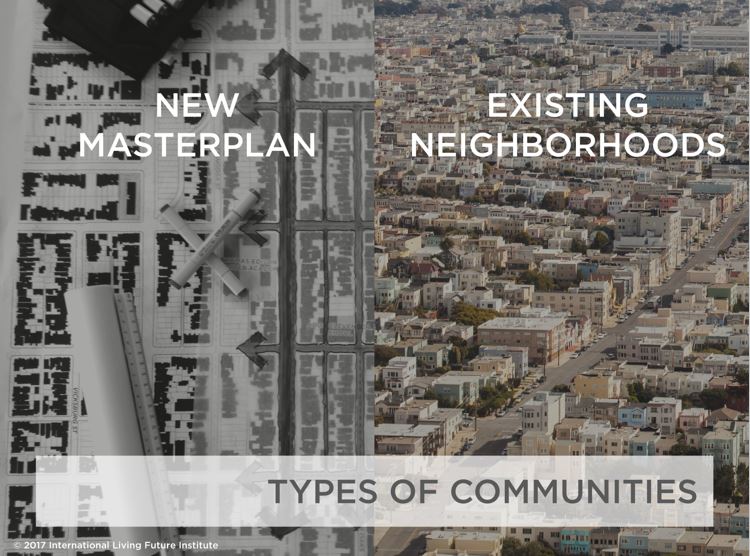
In the a healthier future for the next generations of San Diegans, the framework, being explored by the HN1M Teams, is structured on Transit Oriented growth neighborhoods with targeted Net Zero Design in anticipation of the 2020 Net Zero requirements for all new Residential Construction in California and in support of the Climate Action Plan. LEED for Neighborhood Design, the tenets of the Living Community Challenge, Ecology for Growth, water politics, recycling opportunities, wastewater recycling opportunities, the Mayor’s designated 2030 District; and a healthy vibrant urbanized built environment are all in the toolbox for change.
Having the privilege of working for the Founding Member of AIA Committee on the Environment and the firm that starts with his name - BNIM, my 1970s environmental design work at the University of California at Berkeley is now being implemented through the Housing the Next 1 Million . Our vision for additional growth must be conceived as off the grid in to power, water, and connectivity (e.g. Tesla’s Solar Charged ‘Powerwall’, rooftop PV, and a Powell Water or living machine wastewater recycling system for every unit). Otherwise, consider the cost of new infrastructure that would be necessary for over 400,000 new units at upwards of $20 Billion, and with those costs put on to the developer/builder, it is certain to be passed on to new buyers and renters as higher costs. To control costs, existing infrastructure must be augmented with these sustainable localized systems strategies on an individual unit or block basis. This should be high motivation to embrace these energy and water efficient strategies instead of ripping up streets and sidewalks to enlarge or add to the hundreds of linear miles of regional underground utility systems.
Now is the time to speak out and take action in the U.S. within your communities to address more localized systems in a time where housing affordability is so challenged by inflationary “business as usual” political structures, and the power of mega-business regional utility companies. The opportunity we have is to think globally and act locally. Accordingly, one of the driving forces for this work is the timing and foundational tenets of the “New Urban Agenda.”
Habitat III, the third convening of the United Nations Conference on “Housing and Sustainable Development” held in October 2016 in Quito, Ecuador, included all member states of the United Nations, and the American Institute of Architects. Its aim was to reinvigorate the global commitment to sustainable urbanization and focus on of a New Urban Agenda to address global housing issues. As current patterns of urban development are unsustainable and cities around the world are proving unable to cope with environmental, economic, social, and political shocks and stressors, AIA is committed to promoting this New Urban Agenda and bringing it to San Diego and targeted Cities throughout the US by 2018. The AIA National Strategic Council Committee on the New Urban Agenda is developing a national advocacy and communication strategy that will provides the vision, tools, and guidance to national, state, and local elected public leaders/officials, through local AIA Architects, on methodologies to mitigate the problem of the nation’s housing affordability crisis and comply with Climate Action Plans for resiliency and sustainability.
With the 2020/2030 Challenge and the Living Community Challenge framework you, as architects and citizens for the benefit of future generations can create communities that are:
- Healthy for all elements of life.
- Nurturing and generous places that promote healthy lifestyles for everyone.
- Net Positive with respect to water and energy. Living Communities generate their own energy and capture and treat all the water they need.
- Designed using multipurpose elements. Nothing has only a single purpose; everything has multiple benefits to the community and environment.
- Regenerative spaces for people and natural ecosystems.
As architects, we can and must take a stand on behalf of this sustainable placemaking so the future, in San Diego and around the US, in 2050 absorbs growth with new transit centered micro-villages. Using energy and water self-sufficient design strategies, we can create walkable, bike-able, affordable neighborhoods with a healthier urban ecology, and where small multi-generational urban communities are living, working, learning, playing, farming, and thriving for generations to come.
Philip J. Bona is 2017 President of the San Diego Chapter of the American Institute of Architects, a member of the AIA National Strategic Council, a practicing architect & planner with BNIM | 2011 AIA National Architecture Firm Award Recipient; and a former Assistant Vice President of Architecture and Planning for San Diego’s Redevelopment Agency (CCDC).