by Judge Celeste F. Bremer, US Magistrate Judge, Emily Gloe Donovan, RA, Susan Oldroyd, FAIA, LEED, Kristina Kobulsky, RA, LEED AP
Buildings Express Values: Which design elements read ‘male or female’ and why
When the question of “gendered” courthouses is presented to architects, the initial reaction is that good design is not, and should not be, gendered. However, working through the exercise at the presentation at the AIA AAJ October 2017 Conference, trying to define male and female traits, and how they are represented in justice design, allowed us to take a deeper look into elements of design needed for a new courthouse for today’s citizens and culture. Below are some features that serve as a basis for design conversation with clients, owners, users, and a community. Having a discussion about the gender, or style, of a courthouse calls for a deeper understanding of meanings ascribed to elements that “we’ve always used.” What are ways we can carry on this conversation, and bring fresh thinking to these issues?
|

|
Fortress/Retribution, or Welcoming/Rehabilitation…
Fortress-like courthouses of the past speak of masculine strength and power. The judge sits high up on a pedestal; the entrance is traditionally a grand staircase, and one must be a Member of the Bar to enter the well, or freely move in the space in front of public seating. What would a more welcoming “feminine” courthouse look like? Perhaps its entries would have accessible at-grade entries with softer landscaping, instead of vast hard-scape plazas. Security set-backs can still be met, but with more natural features, such as water, curvilinear paths, and plant material. Without the iconic Greek or Roman or Richardsonian imagery of the past, would we know that this is a courthouse? What signals or forms are we expecting, and why? Are these implicit in design choices? Can a “softer” building connote power, due process, and community values – a place where justice will be seen to be done?
|
|
|
Solid, or Transparent…
Historic solid stone courthouses with small punched window openings may give a feeling of security and stability, but they also infer of secrecy, activities happening behind closed doors. Courts constructed of traditional building materials and construction methods can be read as male. Might new materials and construction methods offering ways to bring light into spaces, and provide safe, but transparent, exteriors read “female?” Light steel frames with large transparent windows say “we have nothing to hide;” Justice is not only done, it is seen to be done. The designer and client have to come to agreement on the level of security, transparency, and circulation within a court facility. Choice of materials is one way to further that discussion, and mindfulness about how traditional choices are perceived, helps provide design choices.
|
 |
Reflection of Past (Precedence), or Forward Thinking (Mindful Framework)…
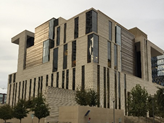
Columns, arches, pediments help identify buildings that are courts, even those dating back over 2000 years. When most courthouses were designed only men were in positions of power (in law and in architecture). Should we continue to repeat past designs, when building technology and program needs have changed, and need to keep adapting? If society is indeed more inclusive, as reflected by different ages, genders, cultures, and status of participants in the justice system, it’s time to push design forward as well. Architects are charged with abstracting what we’ve learned from the past, the cultural context (including gender), to help the client achieve a new framework and symbols that read as a courthouse, where justice is seen to be done.
|
 |
Symmetry, or Asymmetry…
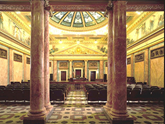
Monumental, understandable, structured, and protective are descriptions of the familiar bilateral courthouses of the past. In contrast, more “female” values descriptions like: elegant, evolving, fluid, or light could be applied to new, more modern courthouses, such as those reflected in the G.S.A. Design Excellence Program*[i]. Designers should explore and explain to clients some of these modern design changes. To have the client and community understand the historical context and future use, and place in the area’s history, the designer has to insist that there be enough time for teaching and learning about a larger philosophical framework about representing justice than just the purpose-driven needs that must be met in the short term.
|
 |
Expected Gravitas, or Reconciliation/Mediation/Specialty Courts…
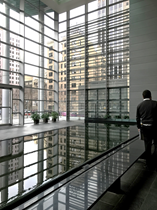
The opulent, grand scaled, display of wealth in historic courtrooms was a way to impose power and authority over its occupants. Placing the judge on a higher bench is a practical matter of sight lines, but also gives them control and commands attention. But justice is delivered not only in adversarial proceedings, but collaboratively, with community input. Most courts now have space available for victim-offender reconciliation programs; mediation; evidence-based treatment courts; or spaces for children and family issues to be resolved. These different methods of justice delivery require flexible, smaller, and less intimidating spaces, as they are usually staffed with a court team. Conference-style seating is needed. Court staff needs flexible space to meet the demands of a variety of court events. A courthouse should offer safe spaces that allow participants and jurors some separation, and helps them feel more at ease, or to decompress from stressful events in court. Increased participation allows the parties to take ownership of the outcome, within the authority and framework provided by the court. The designer has to develop an understanding of the variety of work that is actually performed, and assist the client in envisioning new ways to display power and authority in the delivery of justice.
|
 |
Heavy-handed “Add-0n” Security & Signage, or Integrated Security and Wayfinding…
Security is an ever-changing platform in today’s world. A balance needs to be found, between visible and concealed forms of protection. Heavy-handed or brute, approaches to identify secured space, such as with bollards or Jersey barriers along the street, magnetometers in the entries, and security cameras inside and outside feel oppressive, and can increase anxiety. Security goals, if fully discussed and understood by all the participants, can be met by a lighter design, which integrates security features and wayfinding, while allowing the environment to remain light and open, rather than military and menacing. Is that a female approach? However it is expressed, it does result in good, secure, design, at a reasonable cost. However, you have that discussion with the client, helping them to understand that there are elegant workable solutions might take time, because “we don’t do it that way.”
|
We look forward to continuing this conversation and increasing mindfulness about gendered institutions as we design the next generation of courthouses.
[i] The General Services Administration’s Design Excellence program, started in 1994, has been challenging designers and the courts to expand thinking of what a courthouse looks like, and how it can operate. Almost 50 courthouses and federal buildings have been completed under this program. Data is available through CourtsWeb and maintained by Georgia Tech School of Architecture. By comparing and evaluating some of these new approaches we can see if they are reaching … a more female design.