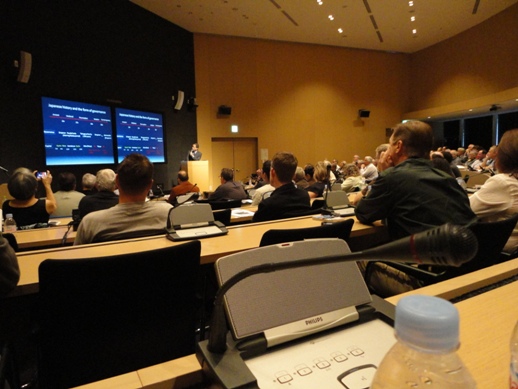
We began the first day of the COD Japan conference with two lectures,
held on the 45th floor of the Mori Building at Roppongi Hills, designed
by KPF. It was a great vantage point to look down on buildings visited
in the last few days. The first lecture was by Masami Kobayashi of
Meiji University. The title of his talk was Japan & the Tohoku Rebuilding Efforts.
Professor Kobayashi described how Tokyo had grown through centuries
of what can only be called calamities– wars, fires, and earthquakes.
Parts of the city were damaged or destroyed and then rebuilt. The city,
therefore, has the texture of many eras of development layered on top
of one another, creating a weaving of old and new, dense development and
open space. He described it as a ‘salami pizza city’.
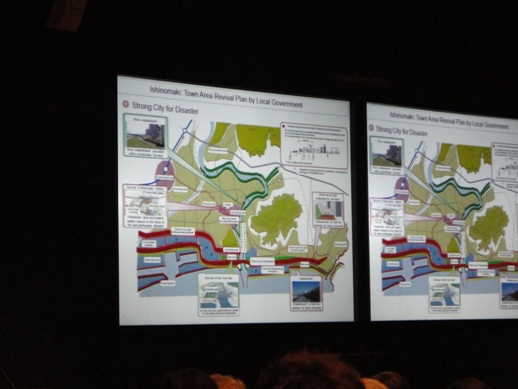
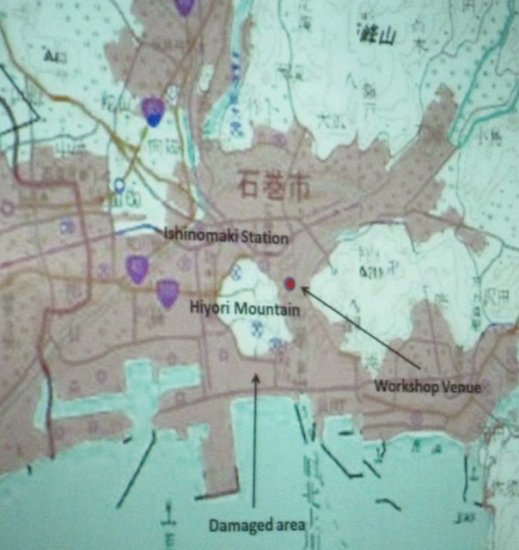
He went on to describe the enormous damage caused in eastern Japan by
the recent (March, 2011) earthquake and tsunami. In helping with the
reconstruction of the coastal towns destroyed by the tsunami he was
finding a unique role for architects. The key, long-term issues are
where and how to restore the communities that were destroyed. One key
issue he and others are struggling with is that if you build a sea wall
high enough to protect a community, you separate them from their key
asset, the sea. The other key issue is a tsunami often destroys part of
a community (the part lowest and closest to the ocean), leaving
developments further back or on hillsides unharmed. The challenge
arises in how to integrate sections of rebuilt areas with the older
surviving ones.
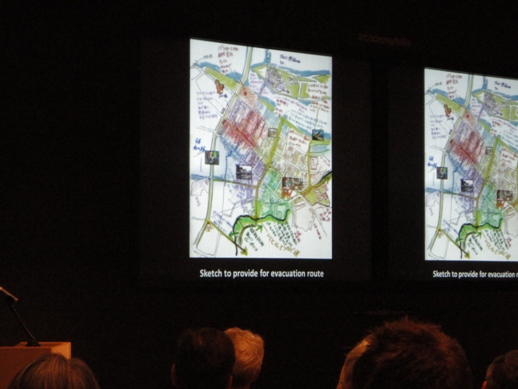
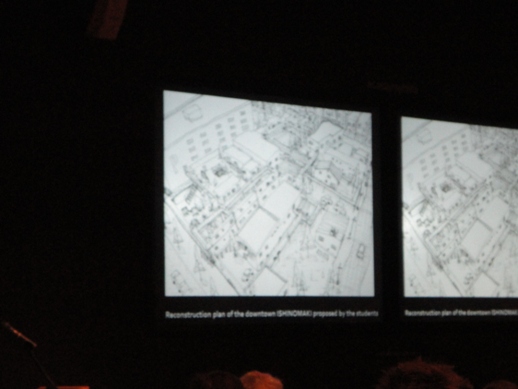
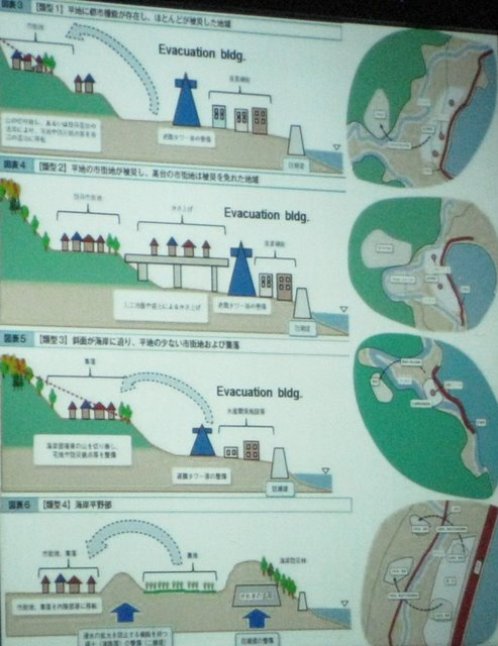
Through charettes, his team of students and faculty are working to find
alternate solutions. One idea is to raise the land; sounds simpler than
it probably is. Another idea is to redevelop the low land but provide
clear and easy paths out for people, i.e., lose buildings in future
tsunamis but not lives. Yet another solution explored how to break a
sea wall into sections that would break up waves yet provide views. I
was impresses that his group was working toward real solutions to
complex, community-oriented issues. The quality of life obtained in the
end for the inhabitants, the fabric of the community, was equally as
important as the civil engineering solution to the problem.
The second lecture follows….
Jim Childress FAIA
Photos courtesy of Jim Childress and Ann Thompson