By David W. Minnigan, AIA / Blueprints for Senior Living newsletter, December 2016
Moving an elderly parent or relative into an assisted living facility is often traumatic, creating angst among all involved. The death of a spouse, upon whom the surviving spouse was dependent upon, or declining health and loss of some faculties are common triggers for such moves. In many cases, when an elderly person lives alone in their own home, socialization and nutrition suffer along with a lack of physical and mental stimulation, causing a further decline in health and quality of life. Sometimes the elderly individual recognizes they can no longer live alone and makes the decision to move into an assisted living arrangement. More often, children of elderly parents are the ones who make the decision that it is time to make the move.
Taking these factors into account, the design of an assisted living community providing different levels of care should facilitate both socialization and nutrition opportunities for residents. The setting concept, supporting assistance in activities of daily living (ADLs), should emulate a comfortable residential environment that is non-threatening, non-institutional, respectful and supportive of some element of independence. More than likely, the children of a potential resident make the rounds of available assisted living facilities. Not only should the facility and its programs satisfy the resident, but assisted living settings should also satisfy the children.
From our years of research and experience designing senior living communities across the country, we have found that including a central social and activity space is the most effective way to encourage socialization among the residents as well as interaction with staff. We have called this particular space the “Country Kitchen.” Centralized, open multi-activity areas for different cognitive levels, as opposed to a collection of hard-to-monitor separate rooms, more readily appeal to assisted-living residents and are preferred by staff. Flexibility should be designed into these spaces so that as needs evolve, the spaces can easily adapt.
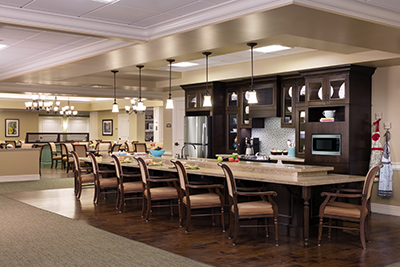 Brookdale Roswell "Country Kitchen." Image credit: Attic Fire Photography
The country kitchen, by its nature, becomes a hub of activity for residents and should be designed so that it allows good visibility for staff and encourages interaction. This layout provides the residents opportunities to access snacks between meals throughout the day and to also get assistance when needed.
Memory care, an advanced level of assisted living, requires more supervision and monitoring by staff. For this level of care, design should create settings that draw upon memories of the past and create connections to former activities to stimulate the brain. One way to achieve these desired outcomes is to plan an enclosed themed town center with replicated facades within the memory care facility. We have found that creating a chapel, movie theater, ice cream parlor or a gardening center within the town center enhances quality of life for people with Alzheimer’s, and other memory-impaired residents. These are successful tools in stimulating both mental and physical activity, and drawing people out of their rooms or residential units.
On the other hand, the designed environment of an assisted living community should be viewed through the eyes of the elderly residents that it is intended to house. Of critical importance is the design of areas for different levels of support to create a balance of activity space options, so as not to overwhelm the resident or create confusion. Complicated wayfinding options do not work well and lead to frustration for residents. Simplistic, easy-to-visualize wayfinding with visible landmarks for destinations work best. We have also found that the most utilized, successful spaces follow the open environment concept, rather than spaced-apart, separate rooms for activities and socialization. For example, an ice-cream parlor in a separate area, several doors away from the game room and living room/den, may become under- utilized and forgotten.
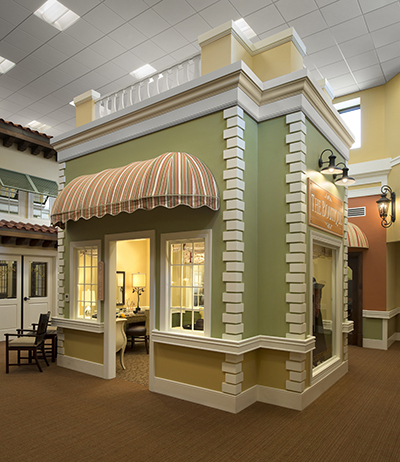 Freedom Pointe at the Villages' facade. Image credit: Michael Peck Photography
As research continues on assisted living and as more baby boomers enter this living arrangement, environments will evolve to satisfy the newer, older generation with their particular interests and familiarity with technology. Nevertheless, the same common thread of design principles that encourage socialization and nutrition will persist as strong elements to incorporate in assisted living. The aesthetics may change, but the need for these features will remain.
_____________________________________
About the author

David W. Minnigan, AIA, IIDA, LEED® AP, a master planner, senior designer and principal at ESa, has worked on a wide variety of building types: education, hospitality, performing arts, senior living, corporate office and community facilities. He helped design the AT&T (a.k.a. Batman Building) in Nashville and has also designed over 130 senior living facilities throughout the country. David stays involved with design oversight and project management, but also focuses on mentoring younger interns, improving quality processes for design and allocating time for community work.