By Erica Loynd and Bob Schwartz, co-chairs to the Sustainable Justice Committee
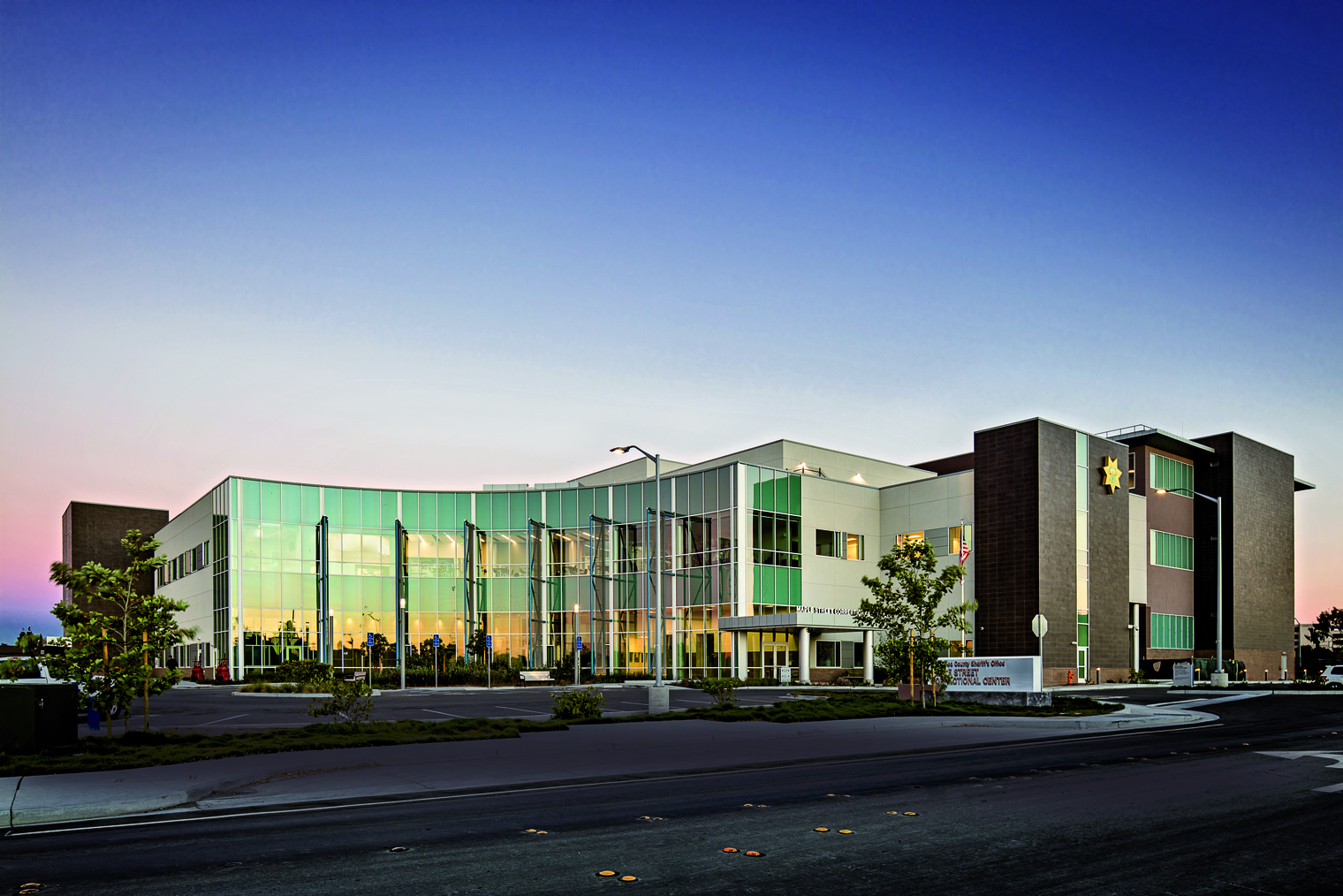
John Swain photographer, courtesy HOK
Implementing sustainable features in buildings has frequently been equated with additional cost, maintenance and complexity. As sustainable initiatives evolve, features accentuating human interaction with the built environment are taking priority. Justice facilities are taking advantage of these attributes and the benefits they have to offer for the owner, staff, and detainees. Post occupancy surveys and statistics indicate these facilities contribute to decreases in staff sick days and turnover rates as well as reductions in recidivism and physical incidents.
The San Mateo County Maple Street Correctional Center achieved the benchmarks of the State of California including a minimum of LEED Silver, CalGreen, San Mateo Countywide Water Pollution Prevention Program, Executive Order B-18-12, California Environmental Quality Act (CEQA), San Mateo County-wide Guide Sustainable Buildings, and California Incentives for efficiency and renewables. The facility is one of the first County jails in California to achieve LEED Gold. Everyone involved including the County, the Sheriff’s Office, the HOK design team, and the Sundt-Layton construction team to worked together to achieve these stringent goals.
California regulations have spearheaded sustainable features more than any entity in the country, and being mandated allows projects and budgets to substantiate sustainable features. San Mateo County was able to achieve these regulations, but focused on measures that reduce recidivism, aid transition and treatment as well as the personal benefits sustainability brings to detention facilities.
Sustainable Justice Guidelines
The Sustainable Justice Committee (SJC) with the Academy of Architecture for Justice (AAJ) saw a gap in the regulated measures and developed standards that prioritizes the sustainable features that directly affect the personal relationship to the facility on four scales – societal, community, facility, and human. To their credit San Mateo County and their consultant team independently pursued these measures as a basis of good design and planning prior to them becoming standards. This resulted in the Maple Street Correctional Center being an award-winning project that can identify sustainability through high performance decisions, social equity, and restorative justice. The following measures were successfully implemented at the campus.
Societal scale
The facility creates a national model for compassionate corrections. Located directly off US Highway 101, it acts as a community gateway and a connection to downtown Redwood City and the growing brownfield redevelopment of a new waterfront community adjacent to San Francisco Bay. The new facility is designed to be an inviting civic facility that is a good neighbor while taking advantage of solar orientation and views.
The community worked together to develop programs and outreach efforts to improve re-entry and decrease recidivism. It supports multiple sentencing programs including weekend work programs, day reporting and transition housing. The facility addresses the need for education and vocational training for detainees. Inmates are provided with spaces and tools that are successful for programming with the use of technology, hands on job skills, and employment support.
The facility is centrally located for a majority of the workforce. Nearby is a central transportation hub, and the facility worked with the local transportation authority for a new bus stop on site. The location is connected to the courts and County Services to minimize transportation between services.
Community scale
Throughout design and construction, stakeholders drove the process with inclusion of the Criminal Justice partners (District Attorney, Judiciary, and Private Defender). The user groups included sworn and civilian staff, probation, medical, program providers, volunteers, and food service staff. Including all groups gave a sense of ownership in the facility design and allowed them to become ambassadors of the facility.
The team included conference space that could be used by the community and other government entities to compensate for a general lack of facilities in the area. The location and flexible design of these spaces allow public access without entering the secure perimeter and offer a variety of configurations, technology and amenities. They are used for training, community meetings, conferences and even graduation ceremonies such as the highly successful TAILS dog training program.
Facility scale
The facility creates a strong civic presence that breaks from a historic jail aesthetic with avoidance of traditional security barriers such as razor wire and narrow security windows. Instead the public is greeted by a curved glass façade focused on natural landscaping and views of the water.
The curve continues inside with the form of the public lobby. Natural materials, abundant daylight along with careful use of color accents provide an inviting, non-institutional space. Security screening is limited to those having to enter the secure perimeter. Family-centered rooms welcome children coming to visit family members and facilitate re-unification. Staff support areas take advantage of the site offering abundant natural light and panoramic views. They include the staff wellness room / gym with natural daylight and panoramic views, locker rooms and a staff dining areas which includes an outdoor patio area. Small break out spaces throughout the facility allow staff areas to decompress. Happier, healthier staff prove reductions in requests for sick leave.
The facility partnered with Recology to design customized garbage, recycling, and composting compactors. They developed policies for separation of waste directly on the pod and within staff areas. Operations protocol centers on green cleaning materials and practices.
Classification matches inmates to housing units conducive to their offenses and rehabilitation opportunities. Maple Street Correctional Center has 832 beds. Of those beds, 704 beds are in a secure tower with male and female general population housing units with either double bed cells or eight person multiple-occupancy rooms. An additional forty beds are housed in high security units. Finishes and housing configurations are designed to meet the classification level of each pod. Objective classification systems ensures inmates are properly housed, and that programming opportunities that are conducive to their needs are provided.
The entry/support building contains three dormitory units for transition housing totaling 88 beds. They provide a more collegial configuration with shared living rooms and restrooms. Robust vocational programming is included in this area. The facility has a state of the art culinary training kitchen where male and female inmates take part in programs designed to teach them skills in the food service industry. Staff has coupled the programming with local job outreach opportunities.
Round the clock nursing and mental health staff are available. The Medical clinic runs Monday through Friday with five waiting rooms, three exam rooms, and a fully functional dental suite with two chairs. They have achieved IMQ certification, and have piloted a program for behavioral health with BSCC support. Operations have a detailed suicide prevention plan with annual training for staff.
Outdoor space for inmates is provided to facilitate programming. Each pod has a covered, outdoor recreation yard adjacent to the dayroom. Under direct supervision, yards are accessible anytime inmates are out of their cell, which is approximately 12-14 hours per day. A centralized recreation area is provided on top of the building for additional recreational and educational opportunities. Originally designed to manage long term inmates it is now used by all. It includes a secure outdoor space with views to the sky.
Extensive programming is available to all inmates at Maple Street Correctional Center. Every floor has classrooms, computer lab, and multi-purpose rooms on the central core. All spaces are interchangeable for the needed use. Programs are supervised by the Core Officer post so no additional staff is needed.
Human scale
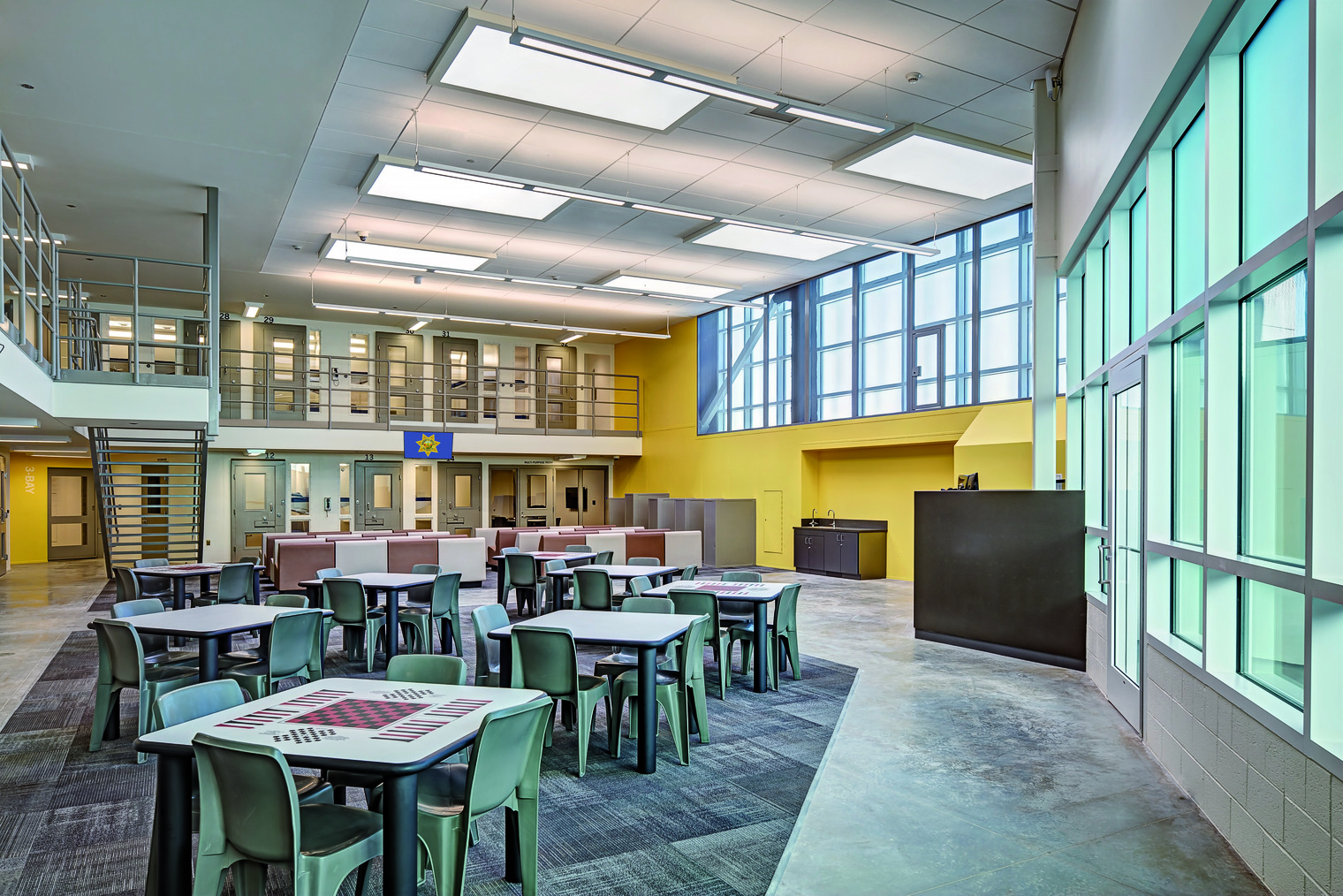
John Swain photographer, courtesy HOK
Special attention was given to meeting improving acoustics within the housing units including acoustical ceilings and carpet tiles in the dayroom which also helped normalize the space. Additional acoustical treatment was added to the program spaces after completion of post occupancy surveys. Open air spaces were designed to reduce entry of outdoor noises from the highway.
Dayroom floors have thermal heating and cooling integrated into the slab. Housing units have operable windows to provide fresh air when temperatures permit. Controls are available throughout the facility in the shared spaces, which is all beneficial for inmates and correctional officers and staff.
The presence of natural daylight is prevalent throughout the facility. Housing units have extensive glazing allowing natural daylight into the dayrooms and extends cells. The top floor, female units, also have skylights. Excellent lighting is provided in all offices, programs, and shared spaces.
The facility uses direct supervision. Building Information Modeling (BIM) provided views in all locations to confirm sightlines and daylighting levels. All cells have intercoms. The facility meets standards set by the Prison Rape Elimination Act (PREA) guidelines.
Use of accent colors shown to reduce stress are included in the departments. Natural art including in the dayroom and transitional housing units is provided. Carpet squares, acoustic panels, soft furniture, and paint colors soften spaces for restorative support.
Conclusion
This facility is a strong success showing the value of progressive programming and sustainability. Not only a strong visual emblem to the County, this facility is a benchmark for detention facilities striving to be more humane, socially responsible, and high performing. It demonstrates how practicing positive development and engaging with operations throughout the design and construction process can create positive results. Special mention must be given to former Sheriff Greg Munks as the driving force behind the project and the support he gave the Jail Planning Bureau to work full time on this project. His vision has been continued by new Sheriff Carlos Bonalos including expansion of inmate programming. Special thanks to Dave Titus, retired Jail Commander for San Mateo County, for his assistance on this article.
The Sustainable Justice Guidelines provide a roadmap for reaching similar results. Imagine the change to the country’s incarceration if every facility could embrace even a portion of these goals.
___________________________________________________
(Return to the cover of the 2017 AAJ Journal Q4 issue)